Barbarossa Rugner: Difference between revisions
More languages
More actions
mNo edit summary |
m Text replacement - "|S1=yes" to "|appears=Suikoden" |
||
| (34 intermediate revisions by the same user not shown) | |||
| Line 1: | Line 1: | ||
{{Character | {{Character | ||
|name = | |name=Barbarossa Rugner | ||
| | |jpname=バルバロッサ・ルーグナー | ||
| | |roname=Barubarossa Rūgunā | ||
| | |img=Barbarossa Rugner (S1 character art) | ||
|caption = Kawano Junko | |caption=Kawano Junko | ||
|gender = Male | |gender=Male | ||
|race = Human | |race=Human | ||
| | |dob=406 | ||
|age = 52 {{S1}} | |age=52 {{S1}} | ||
|from = [[Gregminster | |from=[[Gregminster]] | ||
|family = [[Claudia]] (wife)<br>[[Geil Rugner]] (uncle)<br>[[Kallnach Rugner]] (grandfather)<br>[[Michelan Rugner]] (father) | |family=[[Claudia]] ''(wife)''<br>[[Geil Rugner|Geil]] ''(uncle)''<br>[[Kallnach Rugner|Kallnach]] ''(grandfather)''<br>[[Michelan Rugner|Michelan]] ''(father)'' | ||
|titles= Golden Emperor | |titles=Golden Emperor | ||
|va = [[Banjō Ginga]] | |va=[[Banjō Ginga]]<br><small>(''[[Radio Genso Suikoden: Assemble! 108 Stars!]]'')</small> | ||
|live = [[Kaji Naoto]] | |||
| | |appears=Suikoden | ||
}} | }} | ||
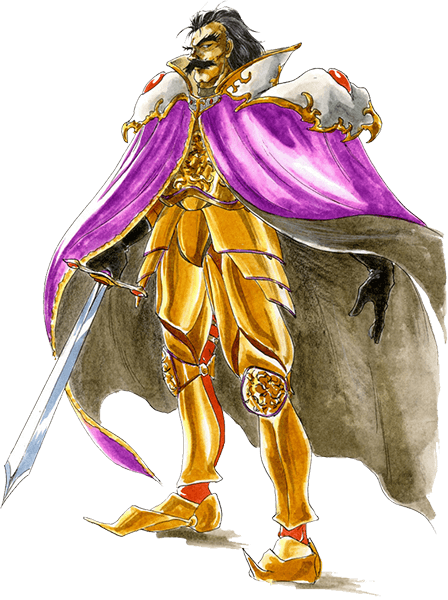
''' | '''Barbarossa Rugner''' (バルバロッサ・ルーグナー, ''Barubarossa Rūgunā'') is a main antagonist in [[Suikoden]]. Barbarossa Rugner was the 17th Emperor of the [[Scarlet Moon Empire]], renowned as the "Golden Emperor" for his golden armor and early benevolent rule. | ||
Rising to power after victory in the [[War of Succession]], his reign began with promise but later declined due to manipulation by the Court Magician [[Windy]], leading to widespread corruption. | |||
In the 1996 English language localization of Suikoden his name was rendered as Barbarosa (no second 's'). | |||
==History== | |||
{{quote| I will defend the last piece of my Empire to the bitter end. | Barbarossa Rugner}} | |||
Barbarossa Rugner, the 17th Emperor of the Scarlet Moon Empire, was a figure of both triumph and tragedy, whose reign was marked by great victories and profound sorrow. Born the sixth son of Emperor [[Michelan Rugner|Michelan]], Barbarossa was initially overlooked in the line of succession, allowing him a childhood of relative freedom among commoners. | |||
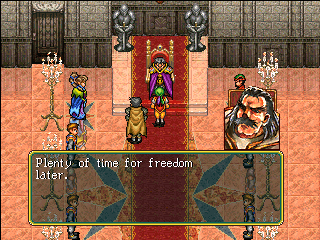
However, the untimely deaths of his elder brothers and the corruption of the remaining heirs led Michelan to name Barbarossa as Crown Prince. Upon his father's death, Barbarossa ascended to the throne, inheriting the [[Sovereign Rune]] and the responsibility of ruling the empire. | |||
Despite | [[File:Barbarosa promises freedom.png|220px|thumb|left|Oh you know it, bro!]] | ||
In year 446 of the [[solar calendar]], Barbarossa's reign was challenged when his uncle, [[Geil Rugner]], seized the throne during his absence, sparking the [[War of Succession]]. Despite early setbacks, including the death of his beloved wife, [[Claudia]], Barbarossa rallied his forces from [[Pannu Yakuta Castle]] and emerged victorious, reclaiming the throne and earning the title of the "Golden Emperor" for his golden armor and benevolent early rule. | |||
However, in [[ | However, his reign took a dark turn in the year 449 when he became enamored with [[Windy]], the Court Magician, who bore a striking resemblance to Claudia. Manipulated by Windy's magic and his own loneliness, Barbarossa allowed corruption to fester within the empire, leading to widespread discontent. | ||
This would eventually manifest as open rebellion by 453, with the rise of the [[Toran Liberation Army]] sparking what would become known as the [[Gate Rune War]]. During the war, he largely withdrew from governance, leaving the defense of the empire to the Five [[Great General]]s while he indulged in his grief and misplaced love. | |||
[[File:Barbarosa nothing beside remains.png|220px|thumb|right|You can become the Republic's official gardener! Deal?]] | |||
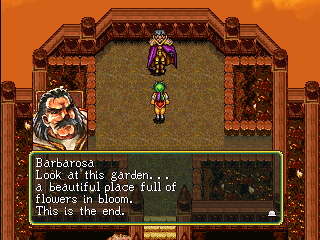
In the final days of the war, as the Liberation Army stormed [[Gregminster]], Barbarossa made a desperate last stand, using the Sovereign Rune to transform into a [[Golden Hydra]]. Defeated, he confessed that his actions were not the result of Windy's manipulation but his own choice, driven by a shared loneliness and his earnest love for her. In a final act of defiance and despair, Barbarossa leapt from the Floating Garden with Windy in his arms, vanishing into history. | |||
Though his body was never found, a memorial was erected in his honor, commemorating the complex legacy of the Golden Emperor. | |||
==Genso Suikoden Card Stories TCG== | |||
{{CS head}} | |||
==Genso Suikoden Card Stories== | {{CS list|CS2-268|[[Barbarossa (CS card CS2-268)|Barbarossa]]|{{Mastermind}}|[[CS2 Booster Pack Vol.3]]}} | ||
{{ | {{CS foot}} | ||
{{ | |||
| | |||
| | |||
| | |||
| | |||
| | |||
}} | |||
}} | |||
==Gallery== | ==Gallery== | ||
===Artwork=== | ===Artwork=== | ||
<gallery> | <gallery> | ||
File: | File:Barbarossa Rugner (S1 character art).png|[[Suikoden]] artwork by [[Kawano Junko]] | ||
</gallery> | </gallery> | ||
===In-Game=== | ===In-Game=== | ||
<gallery> | <gallery> | ||
File: | File:Barbarossa (S1 PS1 portrait).png|[[Suikoden]] Sony PlayStation portrait | ||
File: | File:Barbarossa (S1 SAT portrait).png|[[Suikoden]] Sega Saturn portrait | ||
File:Barbarossa (S1 HDR portrait).png|[[Suikoden I&II HD Remaster]] portrait by [[Kawano Junko]] | |||
</gallery> | |||
===Live performance=== | |||
<gallery> | |||
File:Barbarossa Rugner (TS cast photo).jpg|[[Suikoden -Gate Rune Wars Arc- The Stage]], performed by [[Kaji Naoto]] | |||
</gallery> | </gallery> | ||
==Trivia== | ==Trivia== | ||
* | * Barbarossa was, along with Windy, confirmed as dead following the events of [[Suikoden]]. Since then, however, Konami has decided to downgrade their status to 'Missing in Action', hence the lack of a date of death. | ||
* Presumably named after Emperor Frederic Barbarossa, Operation Barbarossa (in German, Unternehmen Barbarossa) was also the code name for the invasion of USSR by the 3rd Reich, during WW2. | * Presumably named after Emperor Frederic Barbarossa, Operation Barbarossa (in German, Unternehmen Barbarossa) was also the code name for the invasion of USSR by the 3rd Reich, during WW2. | ||
* "Barbarossa" also translates into Italian as "red beard", although the character himself doesn't even have a beard. | * "Barbarossa" also translates into Italian as "red beard", although the character himself doesn't even have a beard. | ||
* | * Barbarossa commissioned the [[Golden Goddess statue]] that is seen in [[Gregminster]] in the likeness of his late wife, Claudia. | ||
==Other languages and releases== | |||
{{flex}} | |||
{{Other Names}} | |||
{{Other Names row|Japanese katakana|バルバロッサ・ルーグナー}} | |||
{{Other Names row|Japanese rōmaji|Barubarossa Rūgunā}} | |||
{{Other Names row|Chinese simplified (HDR)|巴巴罗萨・鲁格纳}} | |||
{{Other Names row|Chinese traditional (HDR)|巴爾帕羅薩・魯格納}} | |||
{{Other Names row|Chinese pinyin|Bā'ěrpàluósà lǔgénà}} | |||
{{Other Names footer}} | |||
{{Other Names}} | |||
{{Other Names row|English (S1)|Barbarosa Rugner}} | |||
{{Other Names row|English (HDR)|Barbarossa Rugner}} | |||
{{Other Names row|French|Barbarossa Rugner}} | |||
{{Other Names row|German|Barbarossa Rugner}} | |||
{{Other Names row|Italian|Barbarossa Rugner}} | |||
{{Other Names row|Spanish|Barbarossa Rugner}} | |||
{{Other Names footer}} | |||
</div> | |||
==References== | ==References== | ||
# [[Genso Suikoden Short Story Collection 1]] (ISBN 4-8402-1494-8), pages 149-76 | # [[Genso Suikoden Short Story Collection 1]] (ISBN 4-8402-1494-8), pages 149-76 | ||
# [[Genso Suikoden Encyclopaedia]] (ISBN 4-575-16297-3), | # [[Genso Suikoden Encyclopaedia]] (ISBN 4-575-16297-3), pages 43, 218-9 | ||
# [[Genso Suikoden Genso Shinsho Vol.7]] (ISBN 4-7753-0044-X), page 91 | |||
# [[Genso Suikoden 108 Stars Character Guide]] (ISBN 4-7753-0050-4), page 151 | |||
# [[Genso Suikoden Genso Shinsho Vol.14]] (ISBN 4-7753-0217-5), pages 66-7 | # [[Genso Suikoden Genso Shinsho Vol.14]] (ISBN 4-7753-0217-5), pages 66-7 | ||
# [[Genso Suikoden Kiwami Encyclopedia]], pages 29, 85 | # [[Genso Suikoden Kiwami Encyclopedia]], pages 29, 85 | ||
{{ | {{Navbox S1 characters}}{{Short description|17th Emperor of the Scarlet Moon Empire}} | ||
[[de:Barbarosa Rugner]] | [[de:Barbarosa Rugner]] | ||
Latest revision as of 12:49, 10 October 2025
.png)
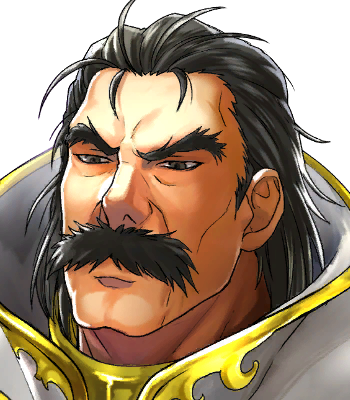
Barbarossa Rugner (バルバロッサ・ルーグナー, Barubarossa Rūgunā) is a main antagonist in Suikoden. Barbarossa Rugner was the 17th Emperor of the Scarlet Moon Empire, renowned as the "Golden Emperor" for his golden armor and early benevolent rule.
Rising to power after victory in the War of Succession, his reign began with promise but later declined due to manipulation by the Court Magician Windy, leading to widespread corruption.
In the 1996 English language localization of Suikoden his name was rendered as Barbarosa (no second 's').
History
|
Barbarossa Rugner, the 17th Emperor of the Scarlet Moon Empire, was a figure of both triumph and tragedy, whose reign was marked by great victories and profound sorrow. Born the sixth son of Emperor Michelan, Barbarossa was initially overlooked in the line of succession, allowing him a childhood of relative freedom among commoners.
However, the untimely deaths of his elder brothers and the corruption of the remaining heirs led Michelan to name Barbarossa as Crown Prince. Upon his father's death, Barbarossa ascended to the throne, inheriting the Sovereign Rune and the responsibility of ruling the empire.

In year 446 of the solar calendar, Barbarossa's reign was challenged when his uncle, Geil Rugner, seized the throne during his absence, sparking the War of Succession. Despite early setbacks, including the death of his beloved wife, Claudia, Barbarossa rallied his forces from Pannu Yakuta Castle and emerged victorious, reclaiming the throne and earning the title of the "Golden Emperor" for his golden armor and benevolent early rule.
However, his reign took a dark turn in the year 449 when he became enamored with Windy, the Court Magician, who bore a striking resemblance to Claudia. Manipulated by Windy's magic and his own loneliness, Barbarossa allowed corruption to fester within the empire, leading to widespread discontent.
This would eventually manifest as open rebellion by 453, with the rise of the Toran Liberation Army sparking what would become known as the Gate Rune War. During the war, he largely withdrew from governance, leaving the defense of the empire to the Five Great Generals while he indulged in his grief and misplaced love.

In the final days of the war, as the Liberation Army stormed Gregminster, Barbarossa made a desperate last stand, using the Sovereign Rune to transform into a Golden Hydra. Defeated, he confessed that his actions were not the result of Windy's manipulation but his own choice, driven by a shared loneliness and his earnest love for her. In a final act of defiance and despair, Barbarossa leapt from the Floating Garden with Windy in his arms, vanishing into history.
Though his body was never found, a memorial was erected in his honor, commemorating the complex legacy of the Golden Emperor.
Genso Suikoden Card Stories TCG
| Card # | Name | Type | Release |
|---|---|---|---|
| CS2-268 | Barbarossa |  |
CS2 Booster Pack Vol.3 |
Gallery
Artwork
-
Suikoden artwork by Kawano Junko
In-Game
-
Suikoden Sony PlayStation portrait
-
Suikoden Sega Saturn portrait
-
Suikoden I&II HD Remaster portrait by Kawano Junko
.png)
.png)
.png)
Live performance
-
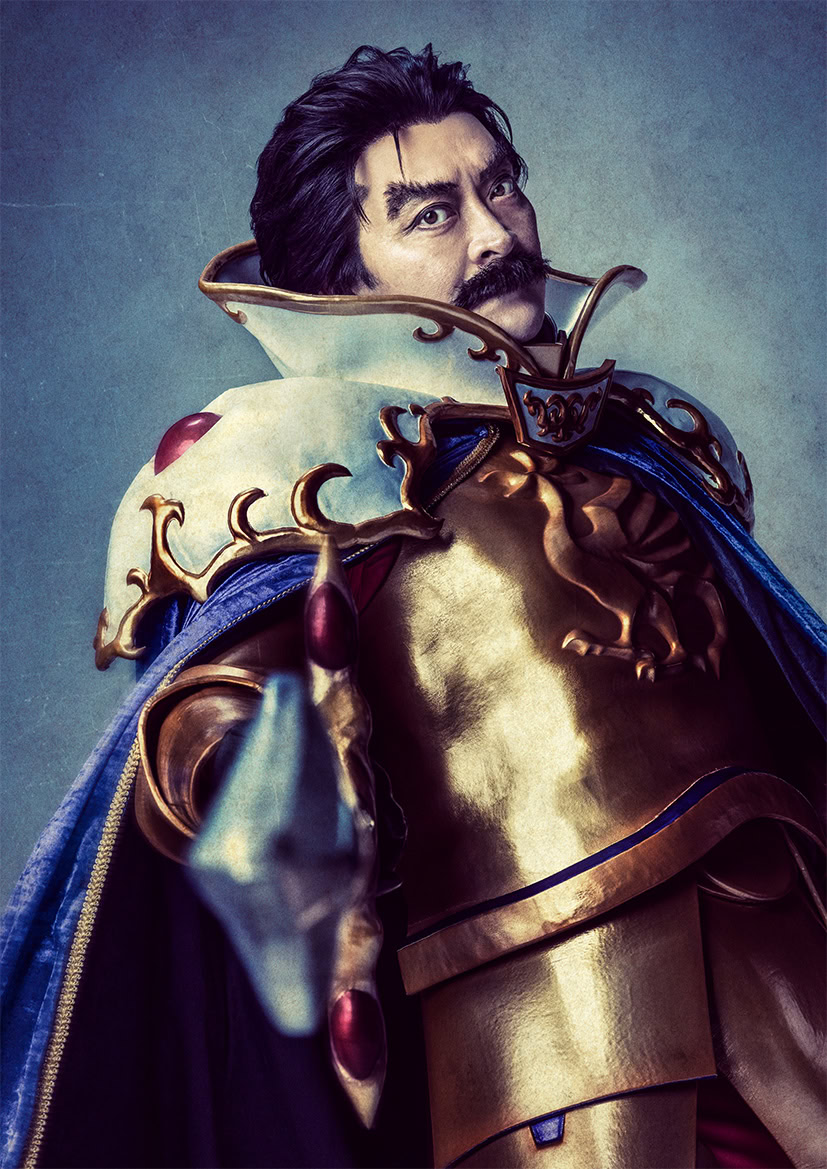
Suikoden -Gate Rune Wars Arc- The Stage, performed by Kaji Naoto
.jpg)


Trivia
- Barbarossa was, along with Windy, confirmed as dead following the events of Suikoden. Since then, however, Konami has decided to downgrade their status to 'Missing in Action', hence the lack of a date of death.
- Presumably named after Emperor Frederic Barbarossa, Operation Barbarossa (in German, Unternehmen Barbarossa) was also the code name for the invasion of USSR by the 3rd Reich, during WW2.
- "Barbarossa" also translates into Italian as "red beard", although the character himself doesn't even have a beard.
- Barbarossa commissioned the Golden Goddess statue that is seen in Gregminster in the likeness of his late wife, Claudia.
Other languages and releases
| Japanese katakana | バルバロッサ・ルーグナー |
|---|---|
| Japanese rōmaji | Barubarossa Rūgunā |
| Chinese simplified (HDR) | 巴巴罗萨・鲁格纳 |
| Chinese traditional (HDR) | 巴爾帕羅薩・魯格納 |
| Chinese pinyin | Bā'ěrpàluósà lǔgénà |
| English (S1) | Barbarosa Rugner |
|---|---|
| English (HDR) | Barbarossa Rugner |
| French | Barbarossa Rugner |
| German | Barbarossa Rugner |
| Italian | Barbarossa Rugner |
| Spanish | Barbarossa Rugner |
References
- Genso Suikoden Short Story Collection 1 (ISBN 4-8402-1494-8), pages 149-76
- Genso Suikoden Encyclopaedia (ISBN 4-575-16297-3), pages 43, 218-9
- Genso Suikoden Genso Shinsho Vol.7 (ISBN 4-7753-0044-X), page 91
- Genso Suikoden 108 Stars Character Guide (ISBN 4-7753-0050-4), page 151
- Genso Suikoden Genso Shinsho Vol.14 (ISBN 4-7753-0217-5), pages 66-7
- Genso Suikoden Kiwami Encyclopedia, pages 29, 85