
War of Succession: Difference between revisions
More languages
More actions
No edit summary |
m Text replacement - "Genso Suikoden I & II Official World Guide Book" to "Genso Suikoden I&II Official World Guide Book" |
||
| (26 intermediate revisions by the same user not shown) | |||
| Line 1: | Line 1: | ||
The '''War of Succession''' (継承戦争 ''Keishō Sensō,'' Succession War) was a major civil war in the [[Scarlet Moon Empire]] in 446 of the [[solar calendar]], sparked by [[Geil Rugner]]'s attempt to usurp the throne from his nephew, the rightful heir [[Barbarossa Rugner]]. | |||
The conflict, marked by strategic battles and the efforts of the Six [[Great General]]s, ended with Barbarossa's victory, securing his reign as the 17th Emperor and earning him the title of the "Golden Emperor." | |||
The | |||
==Information== | |||
[[File:Barbarosa over Geil.png|220px|thumb|right|Congrats, Barbarossa. Don't get bored immediately and let it all fall into ruin now]] | |||
In the year 446 (217 in the [[Scarlet Moon Imperial calendar]]), a great turmoil befell the [[Scarlet Moon Empire]], known thereafter as the War of Succession. This civil strife arose when [[Geil Rugner]], uncle to the legitimate heir [[Barbarossa Rugner]], seized upon the latter's absence—while Barbarossa was away in the [[Kunan]] region—to file a motion in the courts to disinherit him. | |||
This [[Trial of Disinheritance]], concluded in a mere thirty minutes, stripped Barbarossa of his rightful claim to the throne. Thus, the empire was divided, with factions forming around Barbarossa and Geil, and a bitter struggle for the throne ensued. | |||
[[Category:Wars]] | Barbarossa sought refuge at [[Pannu Yakuta Castle]], a fortress built upon the ruins of the ancient [[Sindar]] people. This stronghold, traditionally governed by the Great General of the [[Great Forest]] region, served as the base from which Barbarossa plotted his triumphant return. | ||
In the early stages of the war, Geil's faction held the advantage, for many of his supporters occupied key positions within the imperial military. However, the tide of war shifted dramatically due to the tyranny of Geil, which alienated the people, and the brilliant strategies of the renowned military tactician [[Leon Silverberg]]. | |||
Moreover, the valor and loyalty of the Six Great Generals—esteemed warriors who rallied to Barbarossa's cause—proved decisive. These generals included: | |||
* [[Teo McDohl]], a trusted general known as the undefeatable; | |||
* [[Kasim Hazil]], of the Blue Moon, master of the Blue Moonlight sword; | |||
* [[Milich Oppenheimer]], the Flower General, a peerless swordsman and magician; | |||
* [[Georg Prime]], a warrior renowned as "George Who Needs No Second Strike"; | |||
* [[Kilauea Shulen]], the stalwart navy commander; | |||
* [[Kwanda Rosman]], the ironclad guardian who repeatedly risked his life for his liege. | |||
Together, these generals turned the tide of battle, securing key victories such as the clash at the [[Fortress of Kwaba]], where Geil's officers [[Schmidt]] and [[Bergen (Genso Suikoden Short Story Collection 1)|Bergen]] failed to repel the advance of Teo McDohl. Despite this pivotal triumph, the war raged on for nearly a year, leaving the imperial capital of [[Gregminster]] heavily damaged by its conclusion. | |||
In the end, Barbarossa emerged victorious, reclaiming his rightful place as the 17th Emperor of the Scarlet Moon Empire. The following year, he further solidified his reign by repelling the incursions of the [[City-States of Jowston]], led by [[Tinto Principality]], which had sought to exploit the empire's internal strife. For his valor and leadership, Barbarossa came to be revered by the people as the "Golden Emperor," a ruler both in name and in deed. | |||
==Other figures== | |||
Besides the key figures listed above, several other personalities of note participated in the War of Succession. | |||
* [[Ain Gide]] served as [[Teo McDohl]]'s subordinate during the conflict. | |||
* [[Cleo]] fought in the war as a subordinate of Teo McDohl. | |||
* [[Gremio]] would also fight as a subordinate of Teo McDohl. | |||
* [[Valeria]] fought in the war as a subordinate of [[Kwanda Rosman]]. | |||
* [[Mathiu Silverberg]] served as a tactician for [[Kasim Hazil]] during the war. | |||
* [[Humphrey Mintz]] fought in the war as a subordinate of [[Kasim Hazil]]. | |||
* [[Joshua Levenheit]] would align the [[Knights of the Dragon's Den]] with Barbarossa. | |||
* [[Kreutz]] was a general under [[Geil Rugner]] and was said to be the only such general that be considered on the level of Barbarossa's [[Great General]]s. | |||
* [[Pahn]] was a soldier under Geil who would later defect after being defeated by Teo McDohl in a duel. | |||
==References== | |||
# [[Genso Suikoden I&II Official World Guide Book]] (ISBN 4-471-36033-7), pages 44, 80-1 | |||
# [[Genso Suikoden Short Story Collection 1]] (ISBN 4-8402-1494-8), pages 13-106 | |||
# [[Genso Suikoden Encyclopaedia]] (ISBN 4-575-16297-3), page 96 | |||
# [[Genso Suikoden Genso Shinsho Vol.14]] (ISBN 4-7753-0217-5), page 59 | |||
# [[Genso Suikoden Kiwami Encyclopedia]], page 51 | |||
{{Navbox S1}} {{Short description|Scarlet Moon Empire civil war}} | |||
[[Category:Wars]] [[de: Erbfolgekrieg]] | |||
Latest revision as of 19:17, 17 February 2025
The War of Succession (継承戦争 Keishō Sensō, Succession War) was a major civil war in the Scarlet Moon Empire in 446 of the solar calendar, sparked by Geil Rugner's attempt to usurp the throne from his nephew, the rightful heir Barbarossa Rugner.
The conflict, marked by strategic battles and the efforts of the Six Great Generals, ended with Barbarossa's victory, securing his reign as the 17th Emperor and earning him the title of the "Golden Emperor."
Information

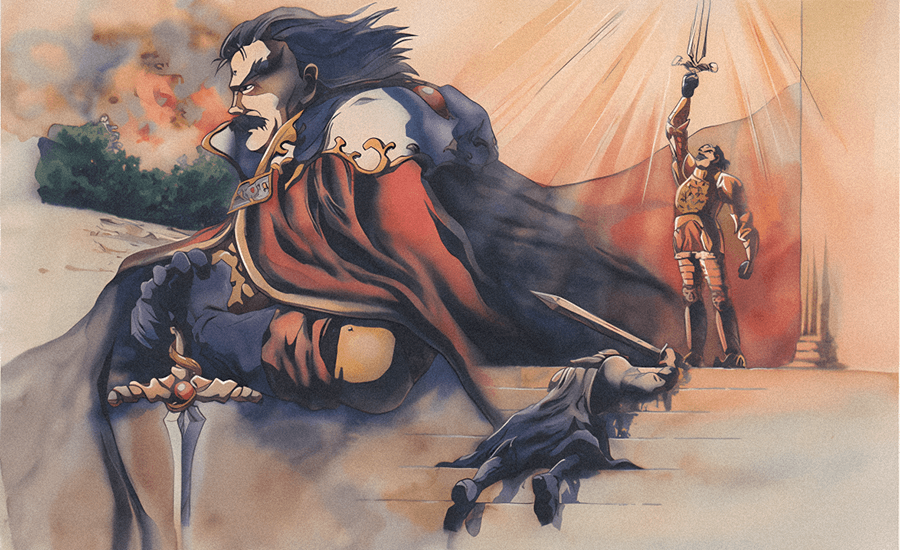
In the year 446 (217 in the Scarlet Moon Imperial calendar), a great turmoil befell the Scarlet Moon Empire, known thereafter as the War of Succession. This civil strife arose when Geil Rugner, uncle to the legitimate heir Barbarossa Rugner, seized upon the latter's absence—while Barbarossa was away in the Kunan region—to file a motion in the courts to disinherit him.
This Trial of Disinheritance, concluded in a mere thirty minutes, stripped Barbarossa of his rightful claim to the throne. Thus, the empire was divided, with factions forming around Barbarossa and Geil, and a bitter struggle for the throne ensued.
Barbarossa sought refuge at Pannu Yakuta Castle, a fortress built upon the ruins of the ancient Sindar people. This stronghold, traditionally governed by the Great General of the Great Forest region, served as the base from which Barbarossa plotted his triumphant return.
In the early stages of the war, Geil's faction held the advantage, for many of his supporters occupied key positions within the imperial military. However, the tide of war shifted dramatically due to the tyranny of Geil, which alienated the people, and the brilliant strategies of the renowned military tactician Leon Silverberg.
Moreover, the valor and loyalty of the Six Great Generals—esteemed warriors who rallied to Barbarossa's cause—proved decisive. These generals included:
- Teo McDohl, a trusted general known as the undefeatable;
- Kasim Hazil, of the Blue Moon, master of the Blue Moonlight sword;
- Milich Oppenheimer, the Flower General, a peerless swordsman and magician;
- Georg Prime, a warrior renowned as "George Who Needs No Second Strike";
- Kilauea Shulen, the stalwart navy commander;
- Kwanda Rosman, the ironclad guardian who repeatedly risked his life for his liege.
Together, these generals turned the tide of battle, securing key victories such as the clash at the Fortress of Kwaba, where Geil's officers Schmidt and Bergen failed to repel the advance of Teo McDohl. Despite this pivotal triumph, the war raged on for nearly a year, leaving the imperial capital of Gregminster heavily damaged by its conclusion.
In the end, Barbarossa emerged victorious, reclaiming his rightful place as the 17th Emperor of the Scarlet Moon Empire. The following year, he further solidified his reign by repelling the incursions of the City-States of Jowston, led by Tinto Principality, which had sought to exploit the empire's internal strife. For his valor and leadership, Barbarossa came to be revered by the people as the "Golden Emperor," a ruler both in name and in deed.
Other figures
Besides the key figures listed above, several other personalities of note participated in the War of Succession.
- Ain Gide served as Teo McDohl's subordinate during the conflict.
- Cleo fought in the war as a subordinate of Teo McDohl.
- Gremio would also fight as a subordinate of Teo McDohl.
- Valeria fought in the war as a subordinate of Kwanda Rosman.
- Mathiu Silverberg served as a tactician for Kasim Hazil during the war.
- Humphrey Mintz fought in the war as a subordinate of Kasim Hazil.
- Joshua Levenheit would align the Knights of the Dragon's Den with Barbarossa.
- Kreutz was a general under Geil Rugner and was said to be the only such general that be considered on the level of Barbarossa's Great Generals.
- Pahn was a soldier under Geil who would later defect after being defeated by Teo McDohl in a duel.
References
- Genso Suikoden I&II Official World Guide Book (ISBN 4-471-36033-7), pages 44, 80-1
- Genso Suikoden Short Story Collection 1 (ISBN 4-8402-1494-8), pages 13-106
- Genso Suikoden Encyclopaedia (ISBN 4-575-16297-3), page 96
- Genso Suikoden Genso Shinsho Vol.14 (ISBN 4-7753-0217-5), page 59
- Genso Suikoden Kiwami Encyclopedia, page 51