
For Love of the Empire: Difference between revisions
More actions
mNo edit summary |
m Text replacement - "{{GS06}}" to "{{Navbox S3}}" |
||
| (3 intermediate revisions by the same user not shown) | |||
| Line 1: | Line 1: | ||
'''For Love of the Empire''' (帝国の愛 ~その光と影~, ''Teikoku no Ai ~Sono Hika to Kage~''), localized as '''Embrace of the Empire ~The Shadows amongst the Light~''' in [[Suikoden III]], is a work mentioned in [[Suikoden II]] and Suikoden III. | '''For Love of the Empire''' (帝国の愛 ~その光と影~, ''Teikoku no Ai ~Sono Hika to Kage~''), localized both as '''Imperial Love: Light and Shadow''' and '''Embrace of the Empire ~The Shadows amongst the Light~''' in [[Suikoden III]], is a work mentioned in [[Suikoden II]] and Suikoden III. | ||
==Information== | ==Information== | ||
[[File:For Love of the Empire.png|200px|thumb|right|Librarian's perks]] | |||
Authored by the [[Scarlet Moon Empire]]'s former Flower General, [[Milich Oppenheimer]], For the Love of the Empire is considered an autobiographical love story. | Authored by the [[Scarlet Moon Empire]]'s former Flower General, [[Milich Oppenheimer]], For the Love of the Empire is considered an autobiographical love story. | ||
Set during the [[Gate Rune War]], the work depicts depicts Milich's own feelings for the last Empress [[Claudia]], his struggles as a [[Great General]], and the doomed love between [[ | Set during the [[Gate Rune War]], the work depicts depicts Milich's own feelings for the last Empress [[Claudia]], his struggles as a [[Great General]], and the doomed love between [[Barbarossa Rugner|Emperor Barbarossa]] and [[Windy]]. | ||
It is highly regarded as an inspiring masterpiece, and was considered a valuable historical document, although Milich took some creative liberties with his writing. [[Emilia]] was a fan of the work, presumably due to its romantic elements. | It is highly regarded as an inspiring masterpiece, and was considered a valuable historical document, although Milich took some creative liberties with his writing. [[Emilia]] was a fan of the work, presumably due to its romantic elements. | ||
Performances of key scenes, such as | Performances of key scenes, such as Barbarossa's final defeat by the [[Toran Liberation Army]] would take place at [[Budehuc Castle]] during the [[War of the Champions]]. | ||
==References== | ==References== | ||
# [[Genso Suikoden Genso Shinsho Vol.13]] (ISBN 4-7753-0182-9), page 41 | # [[Genso Suikoden Genso Shinsho Vol.13]] (ISBN 4-7753-0182-9), page 41 | ||
{{ | {{Navbox S3}}{{Short description|Autobiographical work by Milich Oppenheimer}} | ||
[[Category:Lore]] | [[Category:Lore]] | ||
Latest revision as of 15:47, 1 November 2025
For Love of the Empire (帝国の愛 ~その光と影~, Teikoku no Ai ~Sono Hika to Kage~), localized both as Imperial Love: Light and Shadow and Embrace of the Empire ~The Shadows amongst the Light~ in Suikoden III, is a work mentioned in Suikoden II and Suikoden III.
Information

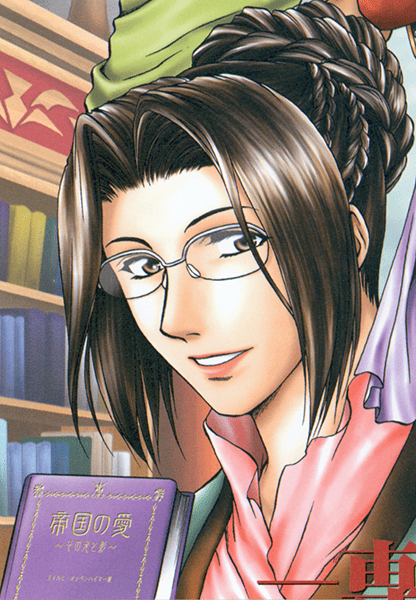
Authored by the Scarlet Moon Empire's former Flower General, Milich Oppenheimer, For the Love of the Empire is considered an autobiographical love story.
Set during the Gate Rune War, the work depicts depicts Milich's own feelings for the last Empress Claudia, his struggles as a Great General, and the doomed love between Emperor Barbarossa and Windy.
It is highly regarded as an inspiring masterpiece, and was considered a valuable historical document, although Milich took some creative liberties with his writing. Emilia was a fan of the work, presumably due to its romantic elements.
Performances of key scenes, such as Barbarossa's final defeat by the Toran Liberation Army would take place at Budehuc Castle during the War of the Champions.
References
- Genso Suikoden Genso Shinsho Vol.13 (ISBN 4-7753-0182-9), page 41